Salt Your Soup Early — Or Watch Your Vegetables Stay Stubbornly Bland
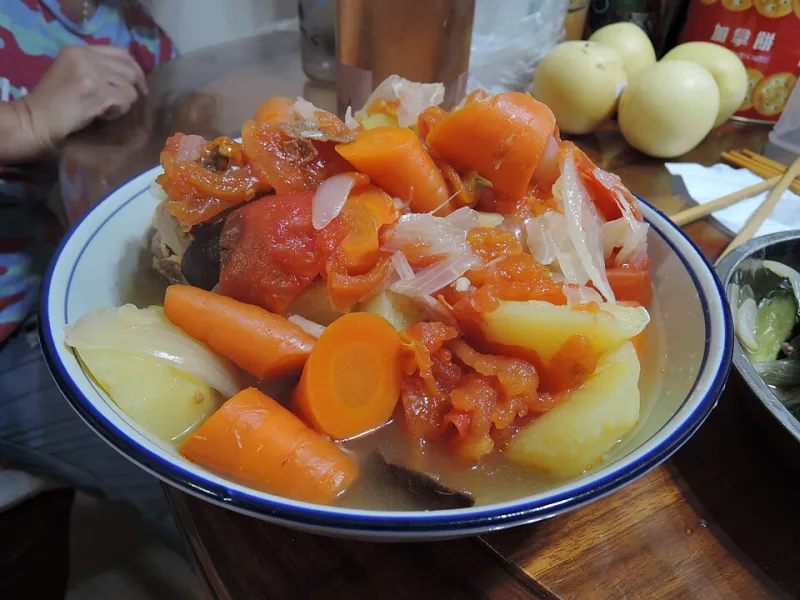
Photo: Apeach316, CC BY-SA 2.0, via Wikimedia Commons
There's a deeply ingrained habit in home kitchens that goes something like this: cook everything, taste at the end, adjust seasoning, serve. It works fine for a lot of dishes. For soup, it quietly undermines everything you're trying to build.
Soup is one of those dishes where the window for seasoning matters as much as the amount. Salt added at the finish tastes sharp and sits on top of the liquid. Salt added at the right earlier stages gets absorbed, diffuses into the ingredients, and becomes part of the flavor rather than a correction to it. The difference in the final bowl is not subtle.
So why do so many cooks wait? Partly habit, partly fear of over-salting, and partly because most recipes bury the instruction at the end. Let's fix that by looking at what's actually going on inside a pot of simmering soup.
Osmosis Is Not Just a High School Biology Word
When you drop a carrot into unsalted water and simmer it, the carrot loses moisture to the surrounding liquid. That's osmosis — water moves from areas of lower solute concentration (inside the vegetable) to higher concentration (the salted or unsalted broth around it). In an unsalted pot, the carrot still loses some moisture, but the gradient is weak. The vegetable essentially steams from the inside out, softening but not really exchanging much with its environment.
Now add salt early. The broth becomes a more concentrated solution. Osmotic pressure increases. Water is pulled from the vegetable cells more assertively, but here's the important part: as the vegetable cooks and its cell walls break down, diffusion kicks in and starts running in both directions. Flavor compounds from the broth — including dissolved aromatics, glutamates from onions and celery, and yes, salt itself — begin moving into the vegetable tissue.
The result is a carrot, or a potato, or a chunk of zucchini that actually tastes seasoned all the way through rather than bland in the center with a salty surface coating.
The Diffusion Timeline You Need to Know
Diffusion is slow. That's the catch. If you're simmering a vegetable for only five or six minutes, salting twenty seconds before you pull it off the heat accomplishes almost nothing structurally. The salt hasn't had time to penetrate.
For most root vegetables — carrots, parsnips, turnips, potatoes — you need at least 15 to 20 minutes of simmering in a properly salted liquid for meaningful flavor absorption. Softer vegetables like zucchini, green beans, or leafy greens need less time, but they also have thinner cell walls, so they respond quickly when the liquid is seasoned from the start.
A useful mental model: think of the broth as a marinade that's actively working while heat is applied. The heat accelerates molecular movement, which speeds up both osmosis and diffusion. Cold water barely seasons anything. Simmering liquid seasons aggressively — but only if you've given it the tools (salt) to do the job.
When to Add Salt, and How Much
Here's a practical framework that works for most vegetable-forward soups:
Stage 1 — With the aromatics. When you're sweating onions, garlic, celery, or leeks at the start, add a small pinch of salt. This draws out moisture from the aromatics, accelerates browning, and starts building a flavor base. A quarter teaspoon for a standard six-quart pot is plenty here.
Stage 2 — When you add liquid. This is the most important moment. Season the broth or water to taste before you add your primary vegetables. It should taste lightly but noticeably salty — not quite as salty as finished soup, but seasoned enough that you'd notice if it weren't there. This is the solution your vegetables are about to spend the next 20 to 40 minutes cooking in. Make it count.
Stage 3 — At the finish. Yes, you still adjust at the end. But if you've seasoned properly throughout, this is a small correction, not a rescue mission. You're fine-tuning, not starting from scratch.
Why Order of Ingredients Actually Matters
The sequence in which you add vegetables to the pot isn't just about cooking them to the right texture — it also affects how much time each one spends in seasoned liquid. Dense vegetables like potatoes and carrots go in early, not just because they take longer to soften, but because they need more time to absorb flavor. Tender vegetables like spinach or fresh herbs go in last, not just to avoid overcooking, but because they need very little time to season through.
If you dump everything in at once, the dense vegetables might technically be cooked, but they'll be significantly less flavorful than if they'd had a proper head start in well-seasoned liquid. The texture might be fine. The flavor won't be.
There's also a subtler point here about starch. Potatoes and starchy root vegetables release starch into the broth as they cook, which slightly thickens the soup and can mute the perception of salt. This means soups with a lot of starchy vegetables often need a touch more seasoning than you'd expect. Tasting as you go — not just at the end — is the only reliable way to stay on top of this.
The Fear of Over-Salting Is Mostly Unfounded
The reluctance to salt early usually comes from a fear of going too far. But over-salting is much harder to do when you're building in stages and tasting as you go. The real risk is actually the opposite: under-salting throughout and ending up with a bowl of warm, vaguely vegetable-flavored water that no amount of last-minute seasoning will rescue.
Salt added at the end hits the palate sharply because it hasn't had time to integrate. It can make a soup taste saltier than the same amount of salt added early and given time to diffuse. So paradoxically, seasoning early and in stages often results in a soup that tastes more balanced and less aggressively salty than one seasoned only at the finish.
The lesson here is less about a specific quantity and more about timing as a technique. Treat salt as an active ingredient that needs time to do its job — not as a last-second adjustment — and your vegetable soup will taste like it was built with intention, not corrected at the last minute.