The Starch Science Behind Gluey Mashed Potatoes — And How to Get a Fluffy, Buttery Bowl Every Single Time
There's a particular kind of kitchen disappointment that hits different. You've boiled the potatoes, you've warmed the butter, and you're feeling pretty good about Thanksgiving dinner — until you take a taste and realize your mashed potatoes have the texture of wet concrete. Dense. Stretchy. Vaguely threatening. What went wrong?
The answer isn't bad luck or a bad recipe. It's starch science. And once you understand what's actually happening inside a potato when you cook and mash it, the fix becomes obvious — and completely repeatable.
What's Actually Inside a Potato
A raw potato is essentially a collection of tiny, rigid cells. Each one is packed with starch granules — little bundles of tightly wound starch molecules just sitting there, waiting. When you submerge a potato in boiling water, heat causes those granules to absorb water and swell up in a process called gelatinization. The cell walls soften. The potato becomes tender and cooks through.
So far, so good. The problem starts the moment you pick up a masher.
When you mash a cooked potato, you're physically breaking those softened cells open. A gentle pass with a ricer or a food mill ruptures the cells just enough to release their fluffy, gelatinized starch in a light, airy way. But keep mashing — or worse, use a blender or a food processor — and you're not just breaking cells. You're grinding them. You're shearing them apart and aggressively releasing the starch molecules inside.
Those freed starch molecules behave like a glue. They link up with each other and with the water present in your pot, forming long, sticky chains that give your mashed potatoes that dreaded gummy, paste-like quality. The more you work the potato after that point, the worse it gets. There's no coming back from it.
Why Your Potato Choice Matters More Than You Think
Not all potatoes are created equal when it comes to mashing, and the difference comes down to starch content and cell structure.
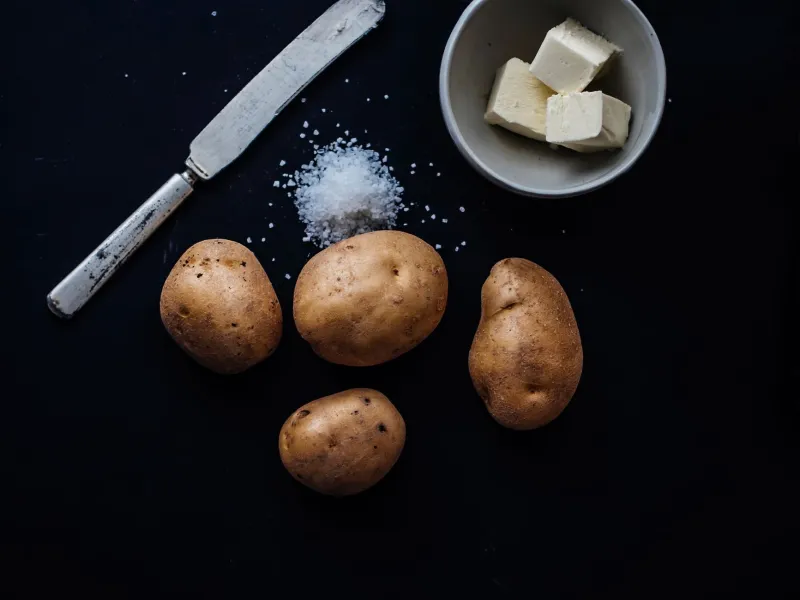
High-starch potatoes — like Russets and Idaho potatoes — have large, dry starch granules and relatively weak cell walls. When cooked, they break apart easily and produce that classic fluffy texture. They're the gold standard for mashing.
Waxy potatoes — like Red Bliss or fingerlings — have a much higher moisture content and lower starch levels. Their cells are also more tightly bonded together, which is great for potato salad (they hold their shape) but disastrous for mashing. Because the starch content is lower and the cells are more resilient, you have to work harder to break them down. All that extra effort means more cell destruction, more free starch, and a gummier result.
Yukon Golds sit in the middle. They're a medium-starch potato with a naturally buttery flavor and a creamy texture that many cooks prefer. They can make excellent mashed potatoes, but they're more forgiving than waxy varieties only if you treat them gently. Overwork a Yukon Gold and you'll still end up with glue.
The takeaway: reach for Russets when you want the most foolproof, fluffy result. If you love the flavor of Yukons, use them — just be extra careful with your technique.
The Method That Actually Works
Now that you understand the science, the practical steps make a lot more sense.
Start with a dry potato. After draining your boiled potatoes, return them to the hot pot over low heat for a minute or two, shaking gently. This drives off excess surface moisture before you add fat. Wet starch is stickier starch.
Use a ricer or a food mill — not a masher, and definitely not a mixer. A potato ricer works by pressing cooked potato through small holes, essentially extruding it in a single pass. This breaks the cells open just once, releasing starch in a controlled, even way without the aggressive shearing that comes from repeated mashing. A food mill does the same thing. Both tools produce a noticeably lighter, more consistent texture than even the most careful hand-mashing.
If you don't own a ricer, a hand masher can work — but you need to stop the moment the lumps are gone. Seriously. The second the texture looks smooth, put the masher down.
Warm your dairy before adding it. Cold butter and cold cream will drop the temperature of your potatoes quickly, causing the starch to set up faster and making you feel like you need to keep mixing to incorporate everything. Warm butter and warm cream (not boiling — just hot) blend in smoothly with minimal stirring. This is one of those small details that makes a real difference.
Fold, don't stir. Once your fat is in, use a rubber spatula and fold the mixture together with slow, deliberate strokes. You're incorporating, not mixing. Think of it less like stirring soup and more like folding whipped cream into a mousse.
Salt at the end, taste as you go. This has less to do with starch and more to do with the fact that potatoes need more salt than most people expect. Season in stages, taste, and adjust.
The One Mistake That Ruins an Otherwise Perfect Batch
Here's the trap a lot of home cooks fall into: they make perfect mashed potatoes, then let them sit in the pot on the stove while they finish the rest of the meal. They come back to check, notice the top has cooled and stiffened slightly, and — thinking they need to loosen things up — start stirring again.
Don't do it. That stirring is what pushes a good batch over the edge into gluey territory. If you need to hold mashed potatoes for a while before serving, keep them warm in a bowl set over a pot of hot water (a double-boiler setup) and cover the surface with plastic wrap pressed directly against the potatoes. This keeps them from drying out or forming a skin without requiring any additional stirring.
The Bigger Picture
Mashed potatoes are one of those dishes that seems simple but actually requires a real understanding of what's happening at a microscopic level. The starch cells in your potato aren't just texture — they're the whole ballgame. Treat them gently, choose the right variety, keep your dairy warm, and stop mashing the moment you hit smooth.
Do those things, and you'll have a bowl of mashed potatoes that's light, rich, and genuinely worth eating — not just a vehicle for gravy to hide in. And once you've made them this way, you'll understand exactly why the gluey version happens, which means you'll never accidentally make it again.