Stop Choosing Your Cooking Oil by Smoke Point — Here's What Actually Matters
Ask most home cooks how to pick a cooking oil and they'll tell you the same thing: check the smoke point. High smoke point for high heat, lower smoke point for dressings and finishing. It's tidy, it's memorable, and it shows up in almost every cooking guide on the internet.
It's also only part of the story — and in some cases, it's actively misleading.
Smoke point matters, but it's one variable in a much more complicated picture. Focusing on it alone can lead you to reach for oils that technically won't smoke at your cooking temperature but will still degrade in ways that affect flavor and potentially your health. Understanding what's really going on when oil meets heat changes how you shop, how you cook, and how your food tastes.
What the Smoke Point Actually Measures
Smoke point is the temperature at which an oil begins to visibly smoke. At that point, the oil is breaking down — triglycerides are splitting apart, and one of the byproducts is acrolein, a compound with a harsh, acrid smell and some evidence of being harmful in large amounts.
The logic goes: if you keep your cooking temperature below the smoke point, you're safe. But here's what that framework misses. Oils don't just start degrading at their smoke point. Degradation — specifically oxidation — begins well before you see any smoke. Free radicals form, flavor compounds break down, and the oil's chemical structure starts changing at temperatures that might be 50 or even 100 degrees below the smoke point.
Some oils with high smoke points are actually quite unstable at lower temperatures. And some oils with moderate smoke points are remarkably stable because of their chemical makeup. The smoke point tells you when things get visibly bad. It doesn't tell you how much invisible damage was already done.
The Real Variable: Saturation and Stability
What actually determines how an oil handles heat is its fatty acid composition — specifically, how saturated or unsaturated those fats are.
Highly saturated fats, like coconut oil, lard, and ghee, are chemically stable. Their molecular structure has fewer double bonds, which means fewer places for oxygen to attack. They hold up well to repeated heating and prolonged cooking without breaking down quickly.
Polyunsaturated fats — corn oil, soybean oil, sunflower oil — have many double bonds, which makes them reactive. They oxidize quickly at cooking temperatures, producing off-flavors and breakdown products even when they haven't technically reached their smoke point. Here's the irony: many of these oils have relatively high smoke points. Refined sunflower oil can smoke above 440°F. But that doesn't mean it's a good choice for high-heat frying. It just means it takes a while to start visibly smoking while it's quietly degrading the whole time.
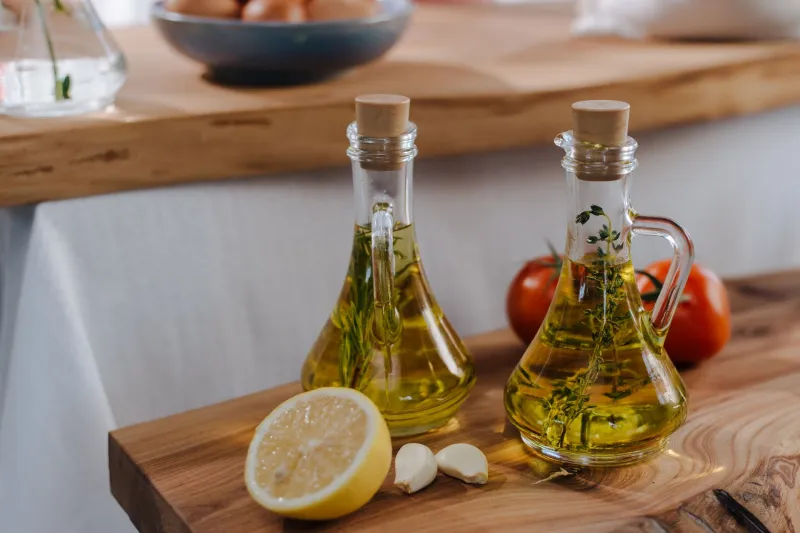
Monounsaturated fats — olive oil, avocado oil, most nut oils — land in the middle. They're more stable than polyunsaturated oils but less so than saturated fats. Extra virgin olive oil, often dismissed as a low-smoke-point oil unsuitable for high heat, is actually quite stable because of its high monounsaturated content and the presence of natural antioxidants like polyphenols that slow oxidation.
Refined vs. Unrefined: The Processing Factor
Refining an oil raises its smoke point by removing impurities, free fatty acids, and the very compounds — antioxidants, flavor molecules — that make unrefined oils interesting. Refined avocado oil smokes above 500°F, which sounds impressive. But it's also a fairly neutral oil that's had a lot of its character processed out.
Extra virgin olive oil, by contrast, is unrefined and has a smoke point that varies between roughly 375°F and 410°F depending on quality and acidity. It's not the right choice for deep frying at 375°F for an extended period. But for sautéing vegetables, searing a piece of fish, or finishing a pan sauce? It performs well and contributes flavor. The polyphenols that give it complexity also act as antioxidants, protecting the oil during cooking.
The practical upshot: a refined oil with a high smoke point isn't automatically a better cooking oil. It's a more neutral one. Whether that's a feature or a bug depends entirely on what you're making.
A Practical Framework That Actually Works
Instead of leading with smoke point, think about two things: the cooking temperature you actually need, and whether you want the oil to contribute flavor.
For very high-heat applications — deep frying, hard searing, wok cooking — you do want a relatively stable oil with a smoke point comfortably above your target temperature. Refined avocado oil, ghee, and refined coconut oil all fit here. Among the seed oils, if you're going to use them, go for ones with higher saturated fat content like palm oil rather than highly polyunsaturated options.
For everyday sautéing and roasting at moderate temperatures (325°F to 375°F), extra virgin olive oil is genuinely a fine choice and a flavorful one. Its reputation for being too delicate for cooking is largely exaggerated.
For dressings, finishing, and any application where the oil isn't heated: this is where flavor-forward, unrefined oils shine. A good California extra virgin olive oil, toasted sesame oil, or walnut oil can transform a dish. Heat would destroy the very compounds that make them worth using.
For frying and any repeated high-heat use, stability matters more than smoke point. Saturated fats and refined monounsaturated oils are your friends.
The Takeaway
Smoke point is a useful data point, not a complete answer. The next time you're standing in the oil aisle trying to figure out what to buy, think about saturation level and whether you want the oil's flavor in the finished dish. Those two questions will get you further than any smoke point chart ever will.