Scrambled Eggs Keep Coming Out Rubbery? The Problem Is Your Stove — Not Your Eggs
Most people learn to cook scrambled eggs the fast way. Crack, beat, dump into a hot pan, push around for two minutes, done. It works, technically. But those eggs — the ones that bounce a little when you fork them, that leave a puddle of liquid on the plate — they're not what scrambled eggs are supposed to be.
The frustrating part is that you can use the best eggs at the farmers market, add cream, add butter, season carefully, and still end up with something that tastes like a diner afterthought. That's because the problem isn't your ingredients. It's your heat.
What's Actually Happening Inside the Egg
Eggs are mostly water and protein. When you apply heat, those proteins — primarily ovalbumin and ovotransferrin in the white, and lipoproteins in the yolk — begin to unfold and bond together in a process called denaturation. At the right temperature, this creates soft, tender curds. Push past that window, and the proteins bond too tightly, squeezing out moisture and turning your eggs into something closer to a rubber eraser.
Here's the key number: egg proteins start setting around 145°F and are fully cooked around 160°F. That's a window of only 15 degrees. A screaming-hot skillet can blow right through that range in a matter of seconds, which is why high-heat scrambled eggs are so unforgiving. You're trying to thread a needle while sprinting.
The water you see pooling on the plate? That's not undercooking. That's actually a sign of overcooking — the proteins contracted so aggressively that they wrung themselves out like a wet sponge.
The Case for Going Slow
Professional cooks at high-end restaurants often spend five to eight minutes on a single portion of scrambled eggs. That sounds absurd until you taste the result — something almost custardy, barely set, with a richness that comes entirely from the egg itself rather than added fat.
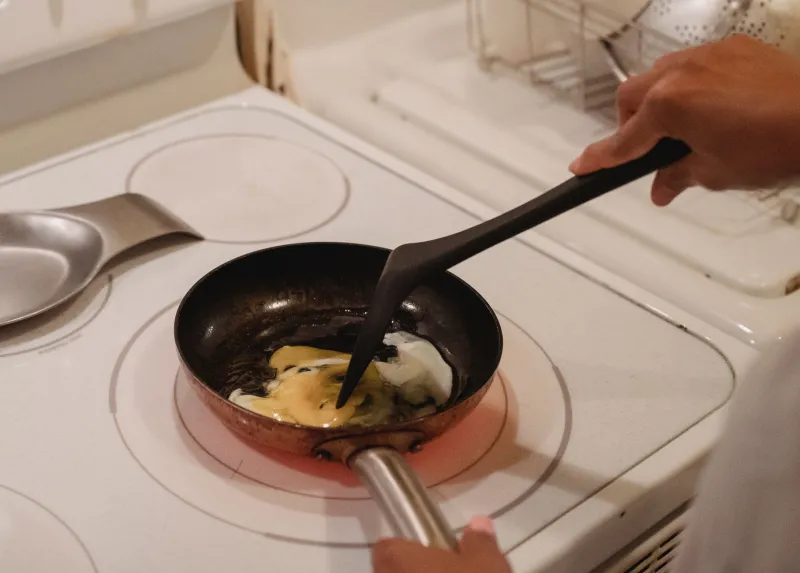
The technique is straightforward but requires patience. Start with a small, heavy-bottomed pan — stainless or nonstick both work. Beat your eggs well with a pinch of salt, and set the burner to the lowest setting your stove allows. Add a small knob of butter and let it melt slowly without foaming. Then add the eggs.
Now stir. Constantly. Not aggressive scrambling, but a steady, deliberate motion with a silicone spatula, moving the eggs from the edges toward the center and folding them over themselves. This does two things: it prevents any one part of the egg from sitting on the hot surface long enough to overcook, and it breaks the curds into smaller, more uniform pieces as they form.
The Pull-Off-the-Heat Move
Here's the technique detail that separates good from great: every 20 to 30 seconds, pull the pan completely off the heat for a few seconds while you keep stirring. This lets the residual heat in the pan do some of the work without adding more. It sounds fussy, but it gives you far more control over that narrow cooking window.
You're looking for the eggs to be just barely set — glossy and slightly underdone-looking when you take them off the heat entirely. Carryover heat will finish the job on the plate. If they look perfect in the pan, they'll look overcooked on the plate.
Salt timing matters here, too. Adding salt to beaten eggs before cooking helps break down some of the protein structure slightly, which actually contributes to a more tender curd. Season before cooking, not after.
Fat Isn't a Shortcut, But It Helps
Adding dairy — cream, crème fraîche, or even a little sour cream — does soften scrambled eggs, but not for the reason most people assume. It's not the fat that helps most; it's the dilution. Adding liquid lowers the overall protein concentration in the mix, which means the proteins have to work harder to find each other and bond. That slightly delays the setting process and gives you a bit more margin for error.
Butter in the pan also helps, but again, not as a flavor band-aid. The fat creates a thin barrier between the egg and the metal, slowing heat transfer just enough to help you stay in that sweet spot.
That said, fat doesn't replace technique. If your pan is too hot, cream won't save your eggs. The temperature is the variable that matters most.
What Good Scrambled Eggs Actually Look Like
Properly made low-and-slow scrambled eggs are almost startling if you've never had them. They're pale yellow, barely set, with soft folds rather than chunks. They hold their shape on the plate without spreading into a puddle. There's no rubbery bounce. They taste deeply eggy in a way that fast-cooked eggs rarely achieve, because the proteins have had time to develop flavor rather than just seize up.
The whole process takes about six to eight minutes for two to three eggs. That's not a lot, but it does mean scrambled eggs are no longer a 90-second thing you make while doing three other tasks. Treat them like the main event, and they'll reward you every time.