The Five Minutes You're Skipping After Cooking Steak Are the Most Important Ones
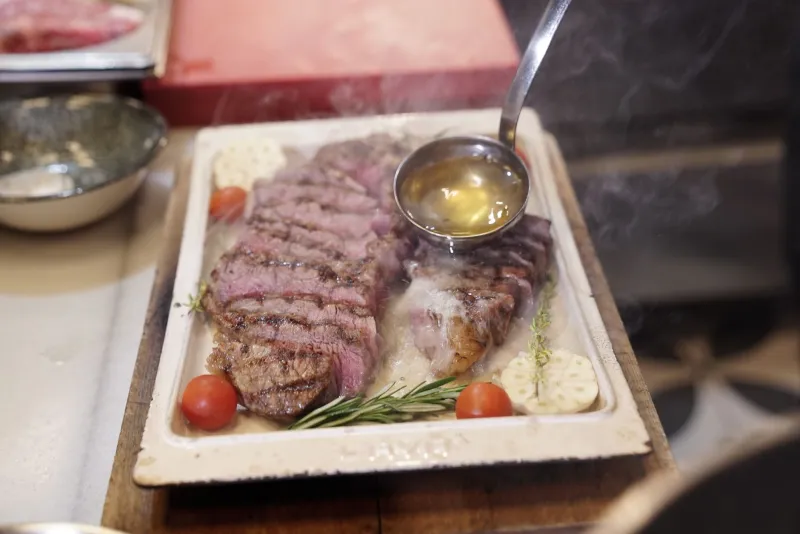
You've done everything right. Dry-brined the steak overnight, got the cast iron screaming hot, achieved a crust that could be on a magazine cover. Then you slice into it immediately because it smells incredible and you are, after all, only human.
A river of juice runs out onto the cutting board. The interior, which looked perfect in the pan, seems a shade or two more cooked than you wanted. And the bite, while still good, is somehow less than the sum of its parts.
That's not bad luck. That's physics — specifically, the physics of what happens to meat proteins under heat, and what they need afterward to deliver on everything the cooking process set up.
What Heat Does to Muscle Fibers
Meat is muscle, and muscle is made up of long protein fibers bundled together in sheaths. When you cook a steak, heat moves from the outside in, and those protein fibers contract. As they tighten, they squeeze the moisture — technically, the myofibrillar water — toward the center of the cut. Think of it like wringing a wet cloth: the harder you squeeze, the more water comes out.
At the moment you pull a steak off the heat, the outer layers are significantly hotter than the center. The proteins near the surface are tightly contracted and actively pushing moisture inward. If you cut into the steak right now, you're opening a pathway for all that centrally displaced moisture to escape immediately. It pours out onto the board, and what looked like a perfectly cooked steak becomes a drier, slightly tougher version of itself.
Resting allows the temperature gradient across the steak to equalize. As the outer layers cool slightly and the center warms from residual heat, the proteins relax. The muscle fibers loosen their grip, and the moisture — which was displaced inward — gets reabsorbed more evenly throughout the meat. Cut into it now, and much less runs out. The juice stays in the steak, where it belongs.
Carryover Cooking: The Hidden Variable
Resting isn't just about moisture. It's also where carryover cooking finishes the job — and where things can go wrong if you're not accounting for it.
Carryover cooking is the continued rise in internal temperature after a piece of meat leaves the heat source. The exterior of the steak is much hotter than the center, and that heat keeps moving inward even after you've pulled the pan off the burner. Depending on the thickness of the cut and how hot you cooked it, a steak's internal temperature can rise anywhere from 3°F to 10°F during the rest period.
This is why you pull a steak off the heat before it hits your target temperature, not at it. Aiming for 130°F for medium-rare? Pull it at 122°F to 125°F and let carryover do the rest. Skip this calculation and you'll consistently overshoot, ending up with a medium steak every time you wanted medium-rare.
Thicker cuts carry over more aggressively than thin ones because they hold more thermal mass. A 2-inch-thick ribeye will keep climbing longer than a 3/4-inch sirloin. Knowing your cut matters.
How Long to Actually Wait
The general rule of thumb — rest for half the cooking time — works reasonably well, but a thickness-based guide is more reliable.
For thin steaks (under 1 inch), three to five minutes is enough. The temperature gradient isn't dramatic, and the proteins don't need long to relax. Waiting much longer actually starts to work against you: the exterior cools too much and you lose the pleasure of a warm crust.
For steaks between 1 and 1.5 inches, five to eight minutes hits the sweet spot. This covers most common cuts — New York strip, ribeye at a standard thickness, flat iron.
For thick cuts — a bone-in cowboy ribeye, a tomahawk, a thick-cut porterhouse — aim for eight to twelve minutes. These cuts have more thermal mass and a steeper temperature gradient, so the proteins need more time to fully relax and the carryover has more work to do.
For large roasts, the math changes entirely. A prime rib or leg of lamb needs a minimum of 20 minutes, and often 30. The center is so far from the exterior that meaningful temperature equalization takes real time.
Why Longer Isn't Always Better
Here's the part that surprises people: beyond a certain point, resting stops helping and starts hurting.
As a steak rests, it continues to lose heat to the surrounding air. Rest it too long and the crust softens as steam from the interior condenses on the surface. The temperature drops below the point where the steak is pleasantly warm throughout. And while the proteins have fully relaxed, the eating experience suffers because food temperature matters to how we perceive flavor and texture.
The solution isn't to tent the steak in foil, either — at least not for individual steaks. Foil traps steam and actively softens the crust you worked so hard to build. For large roasts where a longer rest is necessary, loose foil makes sense. For a steak, just set it on a warm plate and let it be.
Some restaurants use a low oven (around 150°F) to hold rested steaks for service without further cooking them. At home, a plate warmed briefly in the oven serves the same purpose without the fuss.
The One Thing That Ties It Together
Resting meat is one of those techniques that requires nothing — no special equipment, no extra ingredients, no skill — just restraint. And restraint is genuinely hard when something smells that good.
But the science is unambiguous. A rested steak is juicier, more evenly cooked, and better in every measurable way than one cut immediately. The five to ten minutes you spend waiting are doing real work inside the meat. Let them.