Crowded Pan, Mushy Vegetables: The Heat Science Behind a Stir-Fry That Actually Sizzles
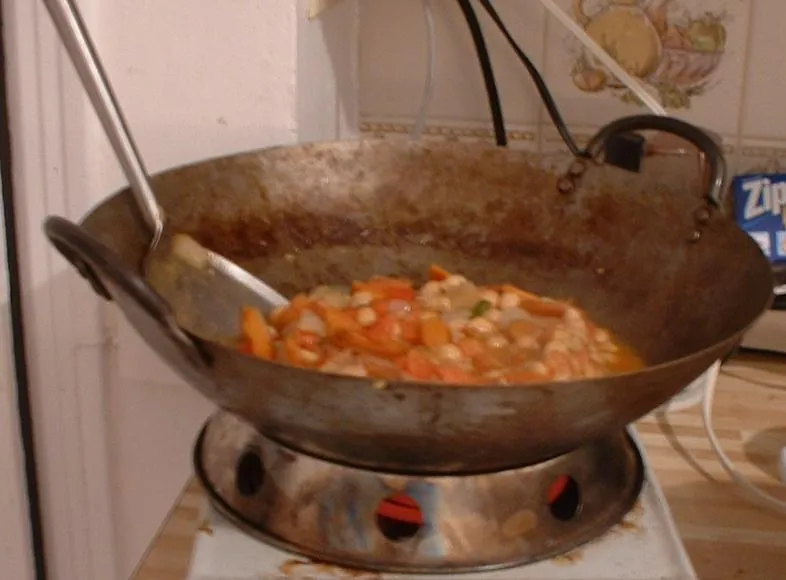
Photo: User Aarchiba on en.wikipedia, Public domain, via Wikimedia Commons
There's a particular kind of disappointment that comes with a homemade stir-fry. You've got the sauce, the aromatics, the colorful pile of vegetables prepped and ready to go. You fire up the burner, add everything to the pan, and twelve minutes later you're staring at a steaming, soggy pile of what used to be broccoli. Restaurant stir-fry has that unmistakable snap — vegetables that are tender but still have some fight in them, with a little char here and there. Yours tastes like it was simmered in a pot. What gives?
The answer lives in cell biology, moisture management, and a heat threshold most home stoves struggle to reach — but can absolutely be worked around if you know what you're doing.
What's Actually Inside a Vegetable (And Why It Matters)
Every piece of broccoli, snap pea, or bell pepper you've ever cooked is built from cells held together by a network of pectin — a structural carbohydrate that acts like biological mortar between bricks. Inside those cells sits water, and a lot of it. A zucchini, for instance, is roughly 95% water by weight. Bell peppers hover around 92%. Even denser vegetables like carrots are pushing 88%.
When heat hits these cells, two things happen in sequence. First, the pectin begins to break down, softening the vegetable. Second, if the heat is aggressive enough and fast enough, that interior water vaporizes and escapes before it has a chance to pool in your pan. The vegetable cooks through without drowning in its own liquid.
But here's the catch: pectin breakdown accelerates significantly between 183°F and 190°F. Get there slowly — say, by adding vegetables to a moderately hot pan — and the pectin collapses before that moisture has anywhere to go. You've just made mush. Get there fast, with brutal, sustained heat, and the outside of the vegetable sears and chars while the inside softens just enough. That's the stir-fry you're chasing.
The Maillard Reaction Is the Whole Point
That light char on restaurant stir-fry vegetables isn't incidental — it's structural to the flavor. The Maillard reaction, which kicks in around 280°F to 330°F on the surface of food, is responsible for hundreds of flavor compounds that give browned food its complexity. It's the same reaction at work when you sear a steak or toast bread, and it requires one very specific condition: a dry surface.
Water is the enemy of the Maillard reaction. As long as there's free moisture in your pan, the temperature of that liquid cannot exceed 212°F — the boiling point of water. Your pan might be registering 500°F on its surface, but if there's a pool of vegetable liquid sitting between the food and the metal, you're effectively steaming everything at 212°F. No char. No complexity. Just gray, soft vegetables.
This is exactly why professional wok cooking uses such violent, concentrated heat. A commercial wok burner puts out anywhere from 60,000 to 200,000 BTUs. Your home burner maxes out around 12,000 to 20,000 BTUs, and that's on a high-end range. You're working with a fraction of the firepower, which means your technique has to compensate.
The Two Mistakes That Kill Your Stir-Fry
Overcrowding the pan. This is the big one. When you add too many vegetables at once, the pan temperature drops sharply — and doesn't recover fast enough. All that vegetable moisture has nowhere to go but the pan floor, where it accumulates and starts steaming everything from below. The solution is to cook in smaller batches, even if it feels slower. A single layer of vegetables with some breathing room between pieces will outperform a heaping pile every single time.
Continuous stirring. The name "stir-fry" is a little misleading. Professional wok cooks do toss their food constantly, but they're working with a BTU output that maintains pan temperature even with movement. At home, constant stirring prevents any individual piece of vegetable from staying in contact with the hot pan surface long enough to develop color. Let the food sit for 30 to 45 seconds between tosses. You want contact time. You want that sizzle.
A Heat Management Framework You Can Actually Use
Here's a practical approach that works on a standard American home range:
Preheat longer than you think you need to. Put your pan — ideally a carbon steel wok or a large cast iron skillet — over your highest burner on maximum heat for at least three to four minutes before you add a drop of oil. The pan should be smoking lightly. This is not optional.
Dry your vegetables completely. After washing, spin them in a salad spinner and then spread them on a kitchen towel for a few minutes. Surface moisture is the first thing that tanks your pan temperature.
Sequence your vegetables by density. Root vegetables and brassicas like broccoli and carrots go in first. Softer items like snap peas, mushrooms, and bell peppers follow about two minutes later. Leafy greens and herbs go in last, off the heat.
Cook your aromatics separately. Garlic and ginger burn almost instantly at the temperatures you need for proper stir-frying. Add them after your vegetables are 80% done, push the vegetables to the sides of the pan, drop the aromatics into the center with a touch more oil, and let them bloom for 20 to 30 seconds before tossing everything together.
Add your sauce at the very end. Sauce introduced too early drops the pan temperature and creates the exact steaming situation you've been working to avoid. Add it in the last 60 seconds, toss quickly, and get the food out of the pan.
One More Thing: The Resting Moment Before You Plate
After the final toss, resist the urge to immediately pile everything onto a plate and add more sauce. Let the stir-fry sit in the pan, off the heat, for about 30 seconds. Any residual moisture evaporates, the sauce tightens slightly, and the vegetables hold their texture rather than continuing to steam under a pile of liquid. It's a small step that makes a noticeable difference.
The gap between restaurant stir-fry and the home version is mostly a gap in understanding, not equipment. Once you know why the pan needs to be hotter, why the batches need to be smaller, and why pectin breakdown is working against you every time you crowd the pan, the fixes become obvious. Your stove can get you there. It just needs a little help from your technique.