Why Your Homemade Dressing Slides Right Off the Salad — And the Emulsion Fix That Makes It Cling
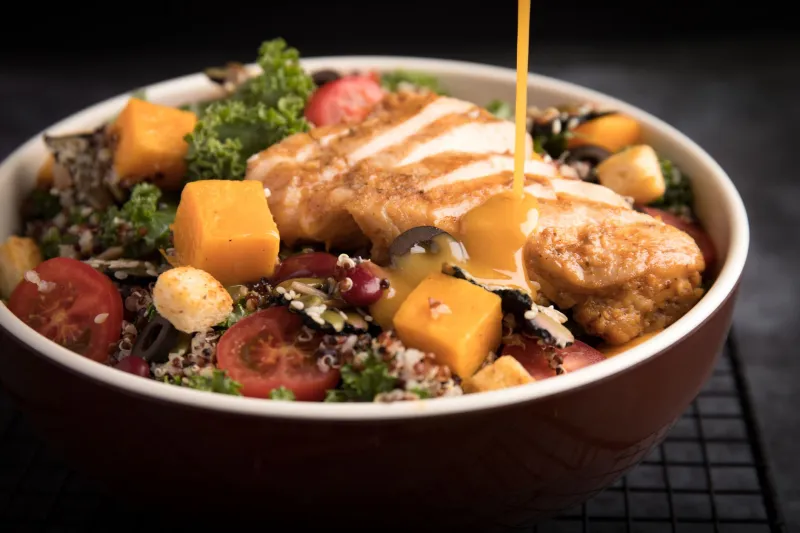
You whisk together olive oil and vinegar, add some Dijon, maybe a squeeze of honey, and pour it over your salad. It looks great for about thirty seconds. Then the oil starts separating, the vinegar pools at the bottom of the bowl, and your greens end up half-dressed and half-drowned. Sound familiar?
This is one of the most common frustrations in the home kitchen, and it almost never gets a real explanation. The usual advice — whisk harder, use a jar, add more mustard — isn't wrong, exactly, but it misses the actual mechanism. To make a dressing that genuinely clings to lettuce, you need to understand what an emulsion is, why it breaks, and how to build one that holds.
Oil and Water Don't Want to Mix — Here's Why They Sometimes Do
At the most basic level, vinaigrette is an attempt to combine two liquids that are chemically incompatible. Oil is nonpolar; water (and vinegar, which is mostly water) is polar. Polar molecules are attracted to other polar molecules and actively repel nonpolar ones. This is why, if you just combine oil and vinegar and shake the jar, they'll separate within a minute or two — the oil droplets are being pushed away from the water molecules at a molecular level.
An emulsion is what happens when you force those two phases to coexist anyway. In a vinaigrette, you're dispersing tiny droplets of oil throughout a continuous water phase. The problem is that without help, those droplets will find each other, merge, and separate back out — a process called coalescence.
This is where emulsifiers come in. An emulsifier is a molecule with a split personality: one end is attracted to water (hydrophilic) and one end is attracted to fat (lipophilic). When you add an emulsifier to your dressing, those molecules position themselves at the boundary between oil droplets and water, physically preventing the droplets from merging. The result is a stable emulsion — one that stays together long enough to coat your greens.
The Two Emulsifiers Worth Knowing
Dijon mustard is the most accessible and most underused emulsifier in a home cook's pantry. Mustard contains mucilage — a complex mix of polysaccharides and proteins — that acts as a surfactant, reducing the surface tension between oil and water. A single teaspoon of Dijon in a standard vinaigrette makes a measurable difference in stability. The emulsion won't last forever, but it'll hold long enough to dress a salad and stay together through tossing.
For a truly stable, creamy dressing — the kind that clings, coats, and doesn't break after sitting in the fridge — egg yolk is your heavy hitter. Egg yolks contain lecithin, a phospholipid that is one of the most effective natural emulsifiers in existence. It's the same compound that makes mayonnaise work, and it's why Caesar dressing, when made properly with raw yolk, has that distinctive thick, clingy texture.
A single egg yolk can emulsify a substantial amount of oil — far more than most dressing recipes call for. The catch is that lecithin works best when the oil is added slowly, giving the emulsifier time to coat each new droplet as it enters the mixture. Rush the process and you'll break the emulsion before it forms.
The Ratio Problem Most People Get Wrong
The standard advice for vinaigrette is a 3:1 ratio of oil to vinegar. That's a reasonable starting point, but it's not a stability target — it's a flavor target. The more oil-heavy your ratio, the harder it is to maintain a stable emulsion, because you have more oil droplets competing for the same amount of emulsifier.
If you want a dressing that clings rather than slides, consider pulling back to a 2:1 ratio, or even closer to equal parts when using a creamy base like tahini, yogurt, or blended avocado. These ingredients contribute both emulsifying power and viscosity, which helps the dressing physically adhere to the surface of a leaf.
Viscosity matters more than most people realize. A thin, watery dressing will always slide off, even if it's technically emulsified. Adding a small amount of a thickener — a spoonful of Greek yogurt, a bit of tahini, or even a small amount of blended roasted garlic — gives the dressing body, which translates directly to cling.
Whisking Technique Isn't Just Arm Exercise
The way you combine oil and your water phase matters. The goal is to create droplets that are as small as possible — smaller droplets have more surface area relative to their volume, which means more opportunity for emulsifier molecules to stabilize them.
The key is adding oil slowly at first. Whether you're whisking by hand or using a blender, start with just a few drops of oil, whisk vigorously to disperse them, then gradually increase to a thin stream. Once the emulsion is established — you'll notice the mixture starting to thicken and turn opaque — you can add oil a bit more quickly.
A blender or an immersion blender makes this dramatically easier because the mechanical action creates much smaller droplets than hand-whisking can. Blended dressings tend to be more stable and have a creamier mouthfeel for exactly this reason.
The Temperature Factor
Cold ingredients make emulsification harder. Cold oil is more viscous and doesn't disperse as easily; cold egg yolk is less effective as an emulsifier. If you're making a creamy dressing with egg yolk, let your ingredients come to room temperature first. It takes ten minutes and makes a real difference.
On the flip side, a dressing that's been refrigerated will often look broken — the fat solidifies and separates — but it's usually not actually broken. Let it sit at room temperature for a few minutes and whisk it again; in most cases it'll come back together easily.
Dry Your Greens
None of this matters if your lettuce is wet. Water on the surface of a leaf creates a barrier between the dressing and the leaf itself, causing the dressing to bead up and slide off rather than adhere. A salad spinner is not optional equipment — it's the thing that makes your dressing work. Spin your greens, then blot them with a clean kitchen towel if you want to be thorough. Dress dry greens and the difference in cling is immediately obvious.