The Science Behind Why Your Vinaigrette Falls Apart — And How to Make One That Actually Holds
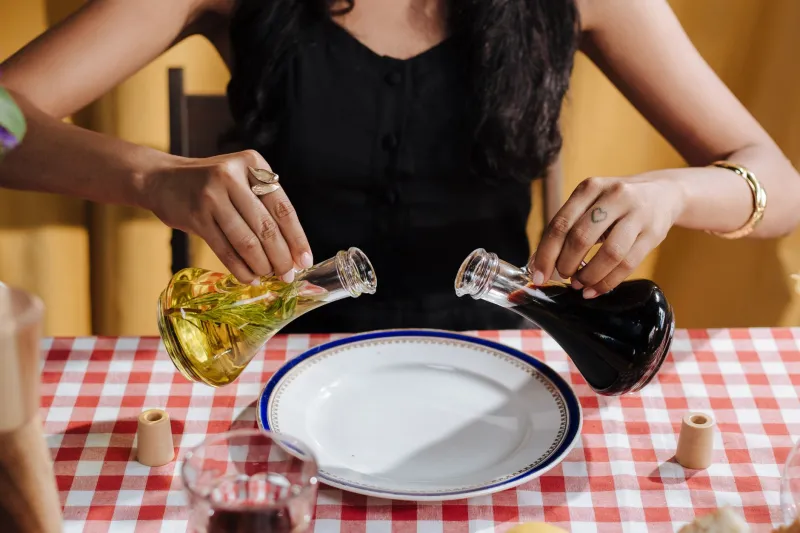
You've done everything right. Good olive oil, decent vinegar, a pinch of salt. You shake the jar hard, drizzle it over your salad, and it looks beautiful for about forty-five seconds before it completely splits apart. Sound familiar?
Here's the thing: that separation isn't a sign that you did something wrong. It's actually chemistry doing exactly what it's supposed to do. Oil and water — or in this case, oil and vinegar — are fundamentally incompatible at the molecular level. Getting them to play nice requires a little more than a vigorous shake. It requires understanding emulsification.
What's Actually Happening When Your Dressing Splits
Water molecules are polar, meaning they have a slight electrical charge that makes them attract other water molecules and repel fat molecules. Oil, on the other hand, is nonpolar — its molecules don't carry that charge. When you shake oil and vinegar together, you're forcing them into temporary contact, breaking the oil into tiny droplets suspended in the vinegar. But the moment you stop shaking, those oil droplets start seeking each other out again, merging back together and rising to the top. That process is called coalescence, and it happens fast.
The result is what food scientists call an unstable emulsion — one that looks uniform for a moment but quickly reverts to two distinct layers. Most homemade vinaigrettes fall into this category, and that's why your salad ends up with a puddle of oil at the bottom of the bowl.
Enter the Emulsifier
An emulsifier is a molecule with a split personality. One end is attracted to water; the other end bonds with fat. When you add an emulsifier to your dressing, it positions itself right at the boundary between oil droplets and the surrounding liquid, essentially acting as a bridge — or a peacekeeper — between two things that would otherwise never get along.
The result is a stable emulsion: one where the oil droplets stay suspended indefinitely rather than rushing back together the moment you set the jar down.
Nature has given us some excellent emulsifiers that are probably already in your kitchen.
Mustard is the most underappreciated one. Dijon mustard contains compounds called mucilage, which are long-chain carbohydrates that coat oil droplets and prevent them from merging. Even a small amount — half a teaspoon in a standard vinaigrette — makes a noticeable difference in how long your dressing holds together. It also adds a gentle sharpness that most vinaigrettes genuinely benefit from.
Egg yolk is the heavy hitter. It contains lecithin, one of the most powerful natural emulsifiers around. A single egg yolk has enough lecithin to emulsify many times its volume in oil, which is exactly why mayonnaise and hollandaise sauce are so stable and creamy. Adding even a small amount of egg yolk to a vinaigrette — especially a creamy Caesar or a rich shallot dressing — completely transforms its texture and staying power.
Honey works too, though more modestly. Its thick, viscous structure helps slow coalescence and adds a bit of body to lighter dressings. Same goes for miso paste, which has the added bonus of packing in a ton of umami flavor.
Technique Matters as Much as Ingredients
Even with a good emulsifier in the mix, how you build the dressing makes a real difference.
The key is to add the oil slowly. When you dump all your oil in at once, you're overwhelming the emulsifier before it has a chance to do its job. Instead, start with your vinegar, mustard, and any other water-based ingredients. Then drizzle the oil in gradually — especially at the beginning — while whisking constantly. This gives the emulsifier time to coat each new batch of oil droplets as they form, creating a tighter, more stable structure.
If you're using a jar (which is perfectly fine), add everything except the oil, then add the oil in two or three additions, shaking vigorously between each pour rather than all at once.
A blender or food processor takes this even further. The high-speed action breaks oil into much smaller droplets than whisking can achieve, and smaller droplets are harder to coalesce. If you want a truly creamy, restaurant-style vinaigrette, a quick blitz is the move.
A Foolproof Ratio to Memorize
Traditional French vinaigrette follows a 3:1 ratio — three parts oil to one part acid. That's a solid starting point, but honestly, modern palates tend to prefer something a little more acidic, closer to 2:1. The right ratio also depends on your acid: red wine vinegar is sharper than champagne vinegar, and lemon juice lands somewhere in between.
For a basic emulsified vinaigrette that holds well, try this:
- 3 tablespoons good olive oil
- 1½ tablespoons red wine vinegar
- 1 teaspoon Dijon mustard
- 1 small garlic clove, finely grated
- Salt and black pepper
Whisk the vinegar, mustard, garlic, salt, and pepper together first. Then slowly drizzle in the olive oil while whisking. That's it. This will hold in the fridge for at least three to four days, and it'll look like you put in a lot more effort than you did.
Why This Changes How You Think About Dressings
Once you understand the role of emulsifiers, you start seeing them everywhere. That creamy tahini dressing that never seems to break? Tahini itself is partially emulsified. The Caesar dressing that clings to every leaf? Egg yolk and Parmesan working in tandem. The bottled dressings at the grocery store that never separate? They're packed with commercial emulsifiers like xanthan gum or modified food starch.
The good news is you don't need any of that to make something better at home. You just need to work with the chemistry instead of against it.
A great vinaigrette isn't just about flavor — it's about understanding what you're building and why. Once you've got that down, you'll never go back to shaking a jar and hoping for the best.